Shamir's Secret Sharing : Session 4
Vikrant Singh
Vice President of Engineering , Codes For Tomorrow
Overview
Deep Dive
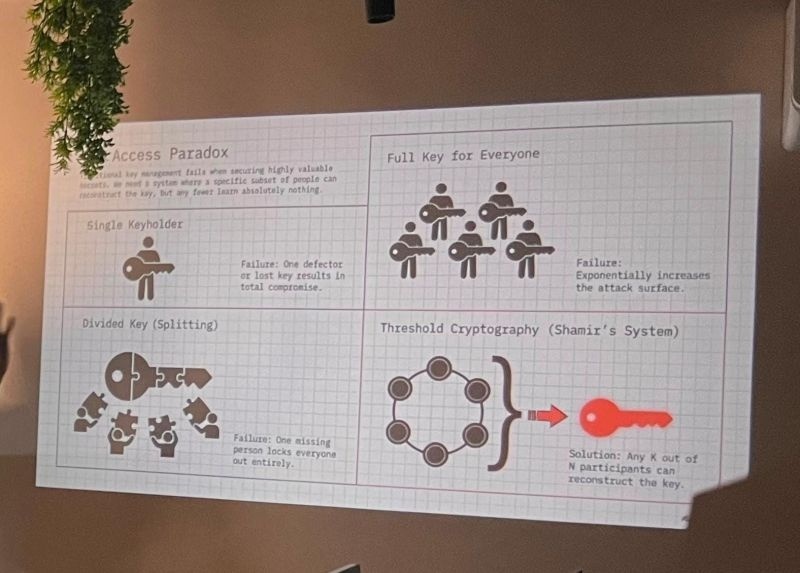
The session began with a motivating problem: how do you protect a highly sensitive secret (e.g., a master encryption key or a cryptocurrency wallet seed) so that no single point of failure — whether a lost device, a compromised employee, or a single stolen backup — can expose or permanently lose the secret?
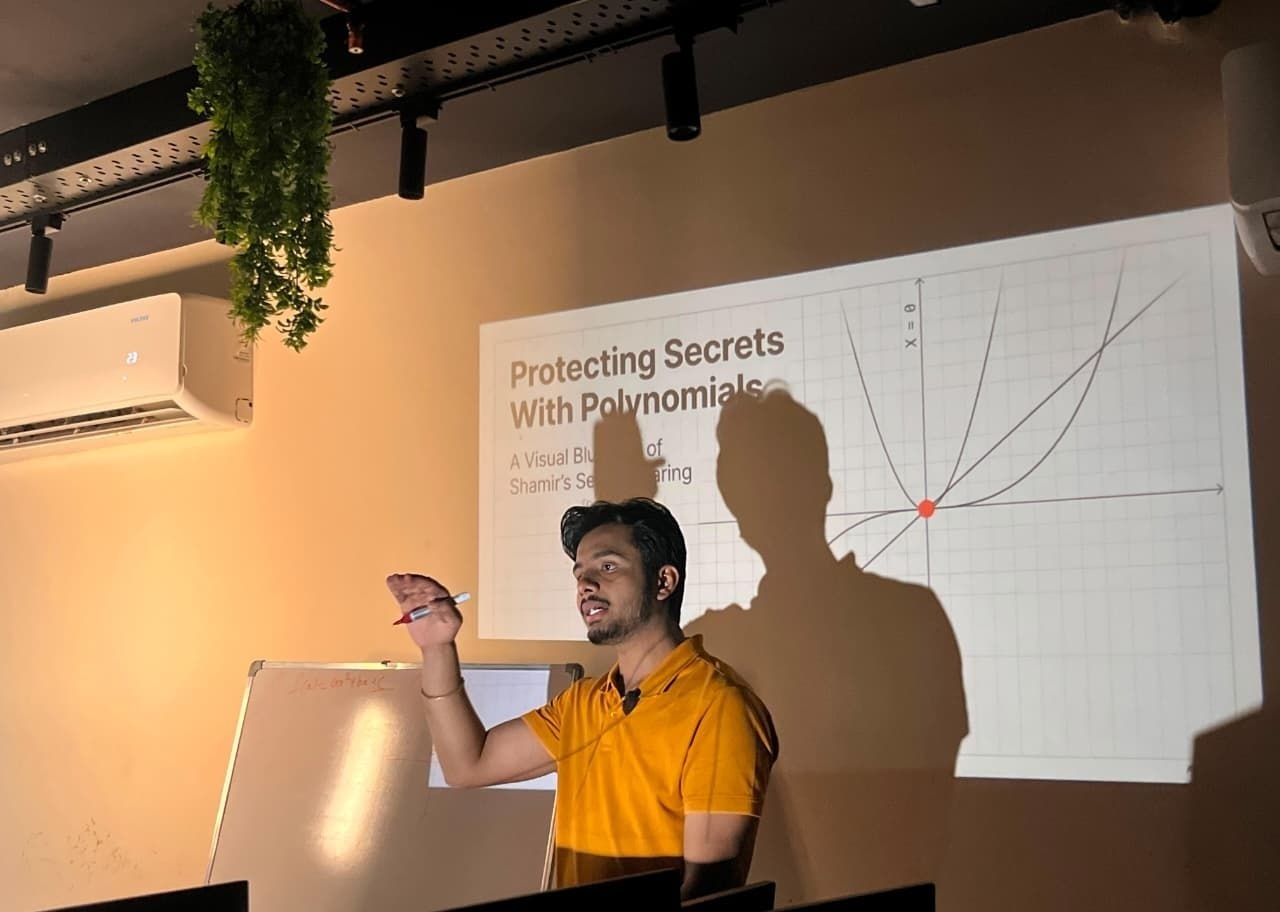
Shamir's Secret Sharing (SSS) was introduced as a solution: a secret is split into n shares such that any k of those shares (where k ≤ n) can reconstruct the original secret, but any k-1 or fewer shares reveal absolutely nothing about it. This is known as a (k, n) threshold scheme.
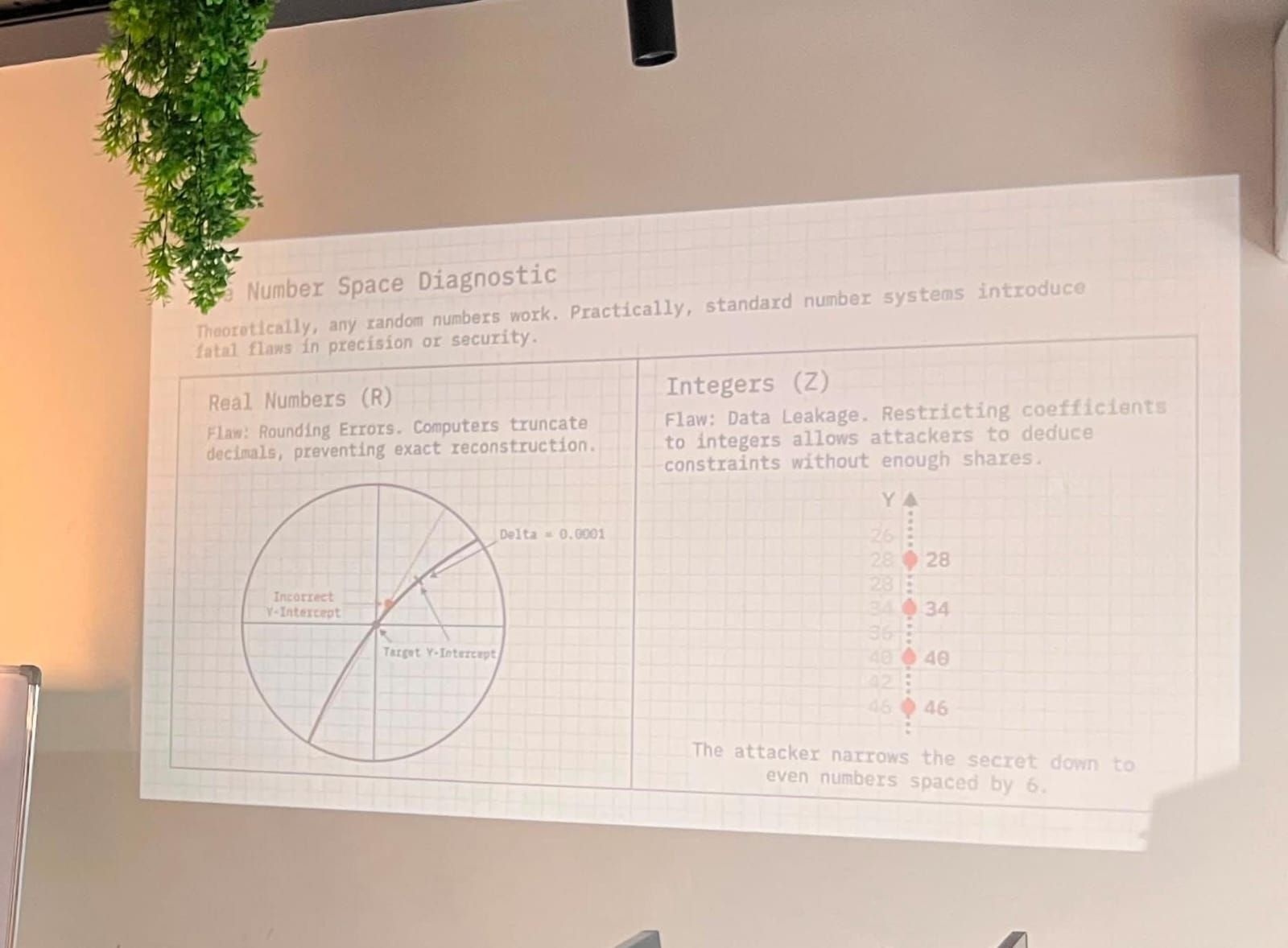
The underlying mathematics — polynomial interpolation over a finite field — was explained step by step:
To split a secret S into n shares with a threshold of k, a random polynomial of degree k-1 is constructed, with the constant term set to the secret S and all other coefficients chosen randomly.
Each share is generated by evaluating this polynomial at a distinct point (e.g., share i is the polynomial evaluated at x = i).
Given any k of these points, Lagrange interpolation can reconstruct the exact polynomial, and therefore recover the constant term — the original secret.
The key insight highlighted was why fewer than k shares reveal nothing: a polynomial of degree k-1 requires exactly k points to be uniquely determined; with fewer points, infinitely many polynomials (and therefore infinitely many possible secrets) remain equally likely, providing information-theoretic security rather than just computational security.
Participants worked through a small worked example: splitting a secret into 5 shares with a threshold of 3, generating each share by evaluating a degree-2 polynomial, and then reconstructing the secret using only 3 of the 5 shares via interpolation.
Real-world use cases discussed included:
Splitting cryptocurrency wallet seed phrases across multiple trusted parties or locations.
Multi-party approval systems where a critical action (e.g., signing a transaction or unlocking a vault) requires cooperation from a threshold number of stakeholders.
Secure backup strategies for root/master keys in enterprise key management systems.
The group also briefly compared SSS to multi-signature (multisig) schemes, noting the key difference: multisig requires multiple independent signatures on the blockchain/protocol level, while SSS reconstructs a single secret off-chain before it is used.
Learning Points
Gallery
Markdown
Participants manually performed a (3,5) secret split and reconstruction exercise using simple integer arithmetic, verifying that any 3 shares reconstructed the same secret while 2 shares alone gave no information.
Outcome :
Participants can explain the (k, n) threshold concept and why it eliminates single points of failure.
Understood the polynomial interpolation mathematics behind Shamir's Secret Sharing.
Learned why SSS provides information-theoretic (not just computational) security below the threshold.
Discussed practical applications in key custody and multi-party approval systems.
Summary
Gallery
Moments from the Centre
From cryptography workshops to research discussions — explore the people, ideas and moments shaping our community.